Beginning with a registration clinical trial
Before formal operation, the hospital conducted a registration clinical trial, establishing its clinical foundations in particle radiotherapy.
China's first hospital offering both proton and heavy-ion therapy, advancing original particle radiotherapy research.
In 2015, Shanghai Proton and Heavy Ion Center became China's first medical institution to offer both proton and heavy-ion radiotherapy. Its major research areas include recurrent nasopharyngeal cancer and brain, abdominal and pelvic tumors. It led an international consensus on carbon-ion treatment for recurrent nasopharyngeal cancer and researches functional imaging-guided simultaneous integrated carbon-ion boosts for prostate cancer. Its tenth-anniversary report recorded 8,039 patients discharged after completing treatment.
Protons and heavy ions are different radiotherapy tools. The hospital's representative experience lies in developing treatment methods, prospective studies and medical physics support around specific problems in recurrent nasopharyngeal cancer, brain tumors and prostate cancer.
China's first dual-particle clinical platform, international consensus on recurrent nasopharyngeal cancer and functional imaging-guided individualized irradiation research together define this specialist hospital.
Based on the 2015 opening and 2025 tenth-anniversary institutional records; the items below describe the platform, research contributions and service volume.
Formal operation began May 8, 2015
Original work and standards development recorded in the 2025 tenth-anniversary review
Cumulative count reported at the tenth anniversary in May 2025
The cumulative number discharged after treatment is not a cure count and is not used to rank outcomes across hospitals.
The hospital studies carbon-ion treatment for nasopharyngeal cancer recurring after previous radiotherapy and led a related international expert consensus. A 206-patient cohort published in 2020 is one representative contribution.
Zhang Qing's team uses functional imaging to identify lesions within the prostate, has established a simultaneous integrated carbon-ion boost technique, and explores more precise treatment through clinical trial design and metabolic research.
The hospital was commissioned to draft clinical trial guidance for particle therapy equipment and participates in health industry and professional standards. Medical physics training and clinical protocols together support precise treatment delivery.
Before formal operation, the hospital conducted a registration clinical trial, establishing its clinical foundations in particle radiotherapy.
It formally opened on May 8, offering both proton and heavy-ion radiotherapy.
The study summarized outcomes and toxicity in patients receiving carbon-ion reirradiation from 2015 to 2019, building clinical evidence for this complex treatment area.
The team published metabolic research on simultaneous integrated carbon-ion boosts and a randomized phase II trial protocol, continuing to investigate the technique's value.
Explore Proton and Heavy Ion Center's contributions in each field, from specialty standing to notable achievements, and the conditions this expertise supports.
Documented in the hospital's 2025 tenth-anniversary review; the contribution concerns this specific disease and technique.
The team focuses on nasopharyngeal cancer recurring after radiotherapy and local treatment of brain and skull-base tumors. Research covers carbon-ion reirradiation, combined proton and carbon-ion approaches, and coordination with drug treatment.
The team systematically analyzed tumor control and acute and late toxicity in patients treated from 2015 to 2019, evaluating benefits and risks within the same study. Kong Lin was a co-corresponding author.
The study design combined a carbon-ion boost with proton radiotherapy and temozolomide, first exploring a safe dose and then planning a randomized comparison. Kong Lin contributed to conception, treatment design and coordination and was the paper's first author.
The dual-particle platform combines medical physics, localization imaging and treatment planning to define irradiation volumes and normal-tissue protection for complex anatomical sites.
The hospital includes multidisciplinary discussion before admission in its particle therapy process, considering pathology, stage, previous treatment and organ risks before setting a plan.
This area is relevant to recurrent nasopharyngeal cancer, complex head and neck tumors and selected brain tumors. Previous dose distributions are particularly important after earlier radiotherapy. Trial protocols describe research approaches and do not establish superiority to standard treatment.
A 2025 Shanghai Medical College profile of Zhang Qing describes it as the first prostate cancer technique of its type internationally, with original research and a randomized phase II trial protocol available.
The abdominal and pelvic team develops particle treatment techniques for prostate cancer, breast cancer and bone and soft tissue tumors, focusing on integration of imaging localization, dose planning and treatment response analysis.
The team designed a comparison of functional imaging-guided simultaneous integrated boosts and conventional carbon-ion irradiation, investigating the benefit and safety of additional dose to lesion areas. The publication is a trial protocol.
The study analyzed metabolic changes before and after carbon-ion radiotherapy combined with androgen deprivation therapy, exploring biological signals of simultaneous integrated boosts. Zhang Qing contributed to study design, experiments and supervision.
Hospital physicians discussed particle radiotherapy for retroperitoneal sarcoma and illustrated dose planning for unresectable lesions. This is an account of professional experience, not a randomized comparative conclusion.
Prostate cancer research combines PSMA PET/CT and multiparametric MRI to localize lesions, supporting target definition and investigation of simultaneous integrated boost plans.
The abdominal and pelvic team brings clinical assessment, medical physics and the dual-particle platform together to discuss how tumor location, normal organs and previous treatment affect the plan.
Patients can explore particle treatment assessment for prostate cancer, bone and soft tissue tumors and retroperitoneal sarcoma. Its place in an overall plan varies with pathological type, resectability and prior treatment.
Discover the specialists' contributions and the conditions and treatments they focus on.
Showing 2 representative specialists
Particle radiotherapy for head, neck and neurological tumors
Chief physician · Doctoral supervisor
Specialist in particle radiotherapy for head, neck and neurological tumors
Ask about this doctorKong Lin has long worked in radiotherapy and combined treatment for head and neck and central nervous system tumors. Her representative work focuses on recurrence after previous irradiation and integration of particle techniques with brain tumor treatment.
In the 2020 Cancer study, Kong Lin contributed to conception, methodology, analysis and supervision, systematically documenting clinical outcomes and toxicity of carbon-ion reirradiation.
The 2019 protocol identifies her role in conception, design and coordination, exploring carbon-ion boosts with proton radiotherapy and temozolomide. This achievement is a study protocol.
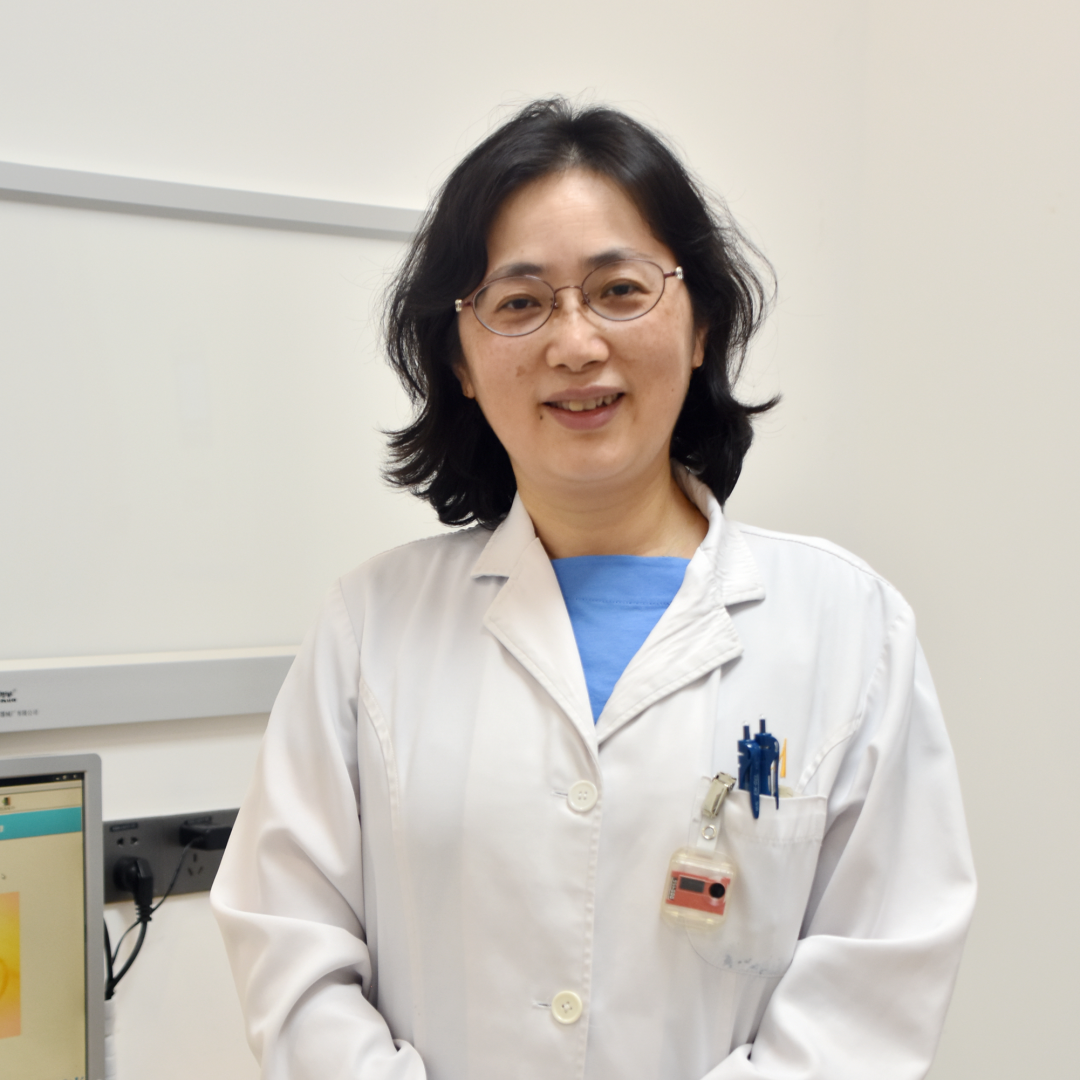
Particle radiotherapy for abdominal, pelvic, bone and soft tissue tumors
Chief physician · Head of Abdominal and Pelvic Oncology
Clinical researcher in functional imaging-guided particle radiotherapy
Ask about this doctorZhang Qing's clinical and research areas include new proton and heavy-ion techniques for prostate, breast, bone and soft tissue tumors, leading translational work around practical treatment questions.
Shanghai Medical College's 2025 profile records that Zhang Qing led development of the first functional imaging-guided simultaneous integrated heavy-ion boost technique for prostate cancer internationally and continues to refine the treatment process.
In the 2022 original paper, Zhang Qing contributed to design, experiments and supervision, exploring metabolic changes in 24 patients before and after carbon-ion radiotherapy combined with endocrine treatment.
These profiles describe professional expertise and notable experience. The doctor, campus and appointment time are confirmed when arranging care.
Tell eastmedgo about the specialty, doctor or care question that matters to you, through WhatsApp or email.
Initial service inquiries are free. Medical assessments and treatment recommendations are provided by the receiving hospital and doctors.
Medical guides related to this hospital’s specialties.