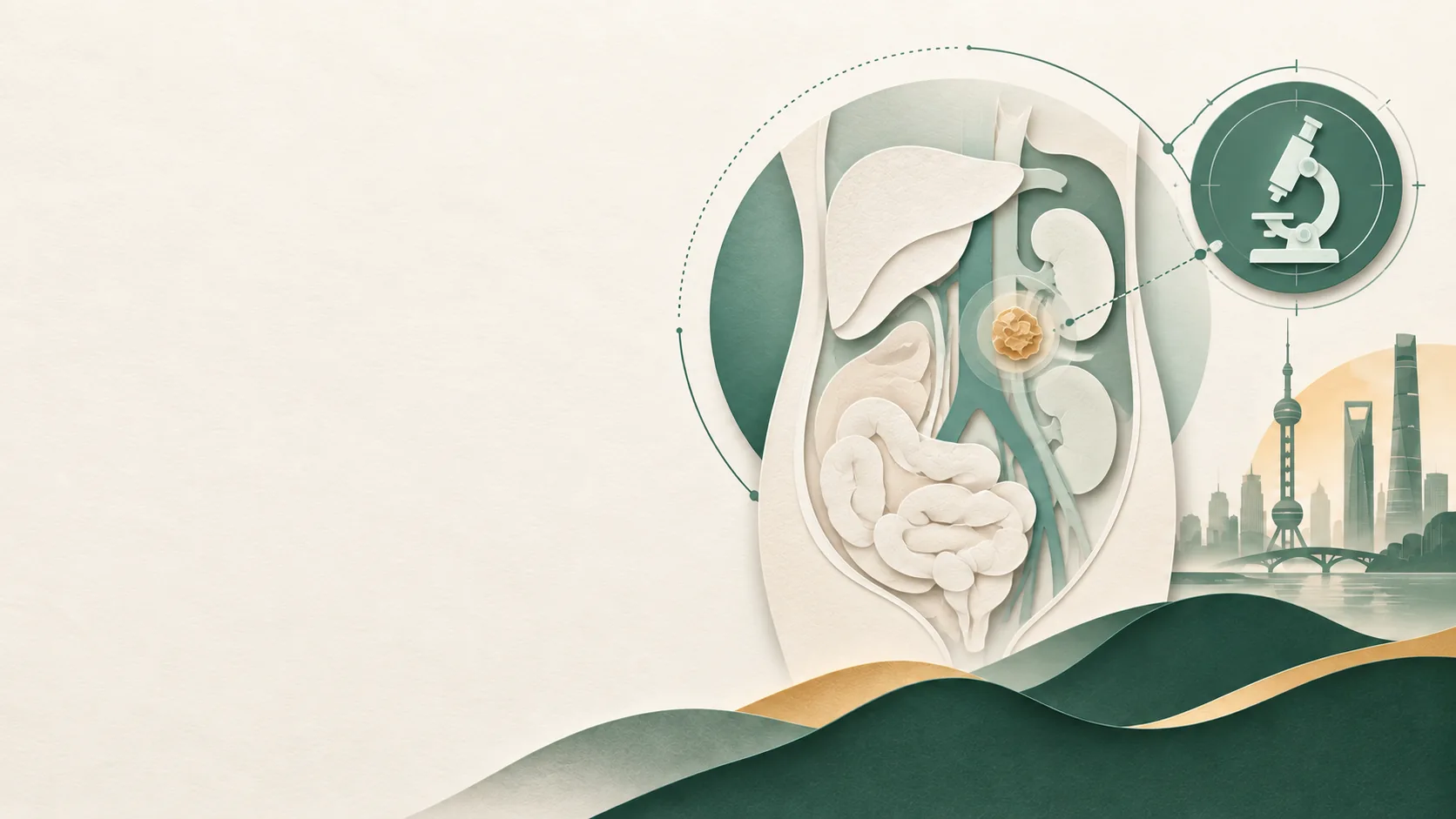
Before treating a retroperitoneal mass: pathology questions for Shanghai
retroperitoneal sarcoma pathology review Shanghai
A retroperitoneal mass can lead quickly to talk of major surgery, yet its subtype and relationship to nearby organs determine the real treatment choices. Shanghai offers a focused pathology, imaging and sarcoma-surgery review before the first irreversible step. That review can turn an uncertain label into a clearer plan for surgery, other therapy and follow-up.
By eastmedgo editorial ·
On this page
The location describes where, not what
Retroperitoneal means the space behind the lining of the abdominal cavity. A mass in that location can have different causes, so its position and size do not establish its tissue type. Even a report that says sarcoma may need a more specific diagnosis before planning treatment. Ask whether the current wording reflects a confirmed subtype, a suspected diagnosis or an incomplete sample. This distinction helps the team decide whether the next priority is reviewing tissue, obtaining a planned biopsy or completing the assessment of a known tumour.
Plan the biopsy with the team that understands the tumour
For suspected retroperitoneal sarcoma, specialist guidance generally favours an image-guided core needle biopsy planned with an experienced team. The route and target matter because the sample must support diagnosis while accounting for nearby structures and later treatment. There are selected exceptions when expert imaging and multidisciplinary review are sufficiently characteristic and no preoperative treatment is planned; patients should not make that determination themselves. A fine needle aspirate and a core specimen are not equivalent. Do not arrange an unplanned open operation merely to find out what the mass is.
Sources and references: [2]
Ask what the pathologist still needs to establish
A specialist sarcoma pathologist may review the tissue appearance, immunohistochemistry and, when relevant, molecular tests to distinguish subtypes. Grade and subtype answer related but different questions: how the tumour is classified is not the same as how aggressive its features appear. Additional testing should address a diagnostic uncertainty, not simply produce a longer list of markers. Ask whether existing slides or blocks are adequate, what the review may clarify and whether a new sample is necessary. Keep the original report as well as any later amended interpretation.
Why a subtype can change a surgical conversation
Different retroperitoneal sarcomas behave differently, including their tendency to recur locally or spread elsewhere. The relationship to kidneys, bowel, nerves and major vessels also affects what complete removal might involve. An operation can therefore require discussion of adjacent organs, functional consequences and recovery, rather than only the tumour's diameter. Specialist guidance places surgery at the centre of potentially curative treatment for appropriate localised disease. That does not make every mass operable, or make chemotherapy and radiation routine additions for every subtype. Treatment goals must follow the whole assessment.
Sources and references: [2]
Shanghai brings sarcoma surgery, pathology and radiation expertise together
Shanghai offers a particularly useful combination for complex retroperitoneal tumours: sarcoma surgery, specialist pathology and radiation expertise in one city. Fudan University Shanghai Cancer Center has a bone and soft-tissue surgery team that works with other surgical specialties on retroperitoneal tumours. Shanghai Proton and Heavy Ion Center adds a radiation consultation when it is relevant to the overall plan. For the patient, the first gain is a careful comparison of diagnosis, operability, organ preservation and the role of any additional treatment—not a choice based on a machine’s name. See our retroperitoneal sarcoma overview for the questions to bring. Learn more about Fudan Cancer Center’s multidisciplinary retroperitoneal sarcoma practice.
When particle therapy belongs in the treatment sequence
If particle treatment is proposed, ask what problem it is intended to solve, whether surgery has been assessed and what alternatives are relevant to this subtype and disease extent. The presence of specialist equipment does not establish that radiation is indicated or superior for every retroperitoneal sarcoma. Nearby bowel and other organs, previous treatment and the achievable treatment plan matter. Ask about expected benefit, tissue toxicity, uncertainty and the consequences of delaying another treatment. Ask the sarcoma and radiation teams to explain the proposed sequence together, including how the plan protects the bowel and other nearby organs.
Make the records usable before the first appointment
Collect complete pathology reports, details of where tissue is stored and the original CT or MRI images. If surgery has already occurred, include the operation note, margin assessment and complications; this changes the question from untreated disease to a previously treated situation. Record drug treatments and dates, and obtain prior radiation plans when relevant. Ask the receiving service how slides, blocks or digital files should be supplied before sending anything. A useful referral summary states what remains unresolved, such as subtype, whether further tissue is needed or the rationale for a proposed treatment sequence.
How eastmedgo coordinates a sarcoma treatment decision
The strongest first visit is one that reaches a documented decision: what the tumour is, whether more tissue is needed, which team should lead treatment and what the proposed sequence means for nearby organs. eastmedgo knows China’s specialist resources and can organize scans, pathology material and prior treatment into a focused referral, match the relevant Shanghai team, coordinate language and visit arrangements, and return a clear record to the local doctor. We can help separate the cost of diagnostic review from the eventual treatment plan. Contact eastmedgo before committing to surgery or particle therapy on the basis of an incomplete diagnosis.
Common questions
Does a large retroperitoneal mass definitely mean sarcoma?
No. Location and size alone do not establish the diagnosis. Imaging and specialist assessment help define the possibilities, and carefully planned tissue evaluation is usually important before committing to treatment for a presumed retroperitoneal sarcoma.
Will a needle biopsy spread the tumour?
Specialist guidelines describe a very low, but not zero, risk of needle-tract seeding with properly planned core biopsy. The team should explain the technique and individual risks. Concern about spread should be discussed with specialists rather than used to justify skipping diagnosis or arranging an unplanned open biopsy.
Sources and references: [2]
If Shanghai offers heavy ions, can I avoid surgery?
Particle treatment is one question within the overall plan, not a substitute automatically chosen because a center has the technology. For suitable localized retroperitoneal sarcoma, surgery remains a central option. A Shanghai sarcoma team can explain when radiation may add value and how its risks compare with the surgical plan.
Sources and references
- National Cancer Institute — Soft tissue sarcoma treatment
- British Sarcoma Group — UK guidelines for the management of soft tissue sarcomas, 2024
- Fudan University Shanghai Cancer Center — Retroperitoneal sarcoma multidisciplinary surgical practice, 2022
- Shanghai Municipal Government — Shanghai Proton and Heavy Ion Center
- Wang, Bao and Jiang — Proton and heavy ion radiotherapy in retroperitoneal sarcoma, expert forum, 2022