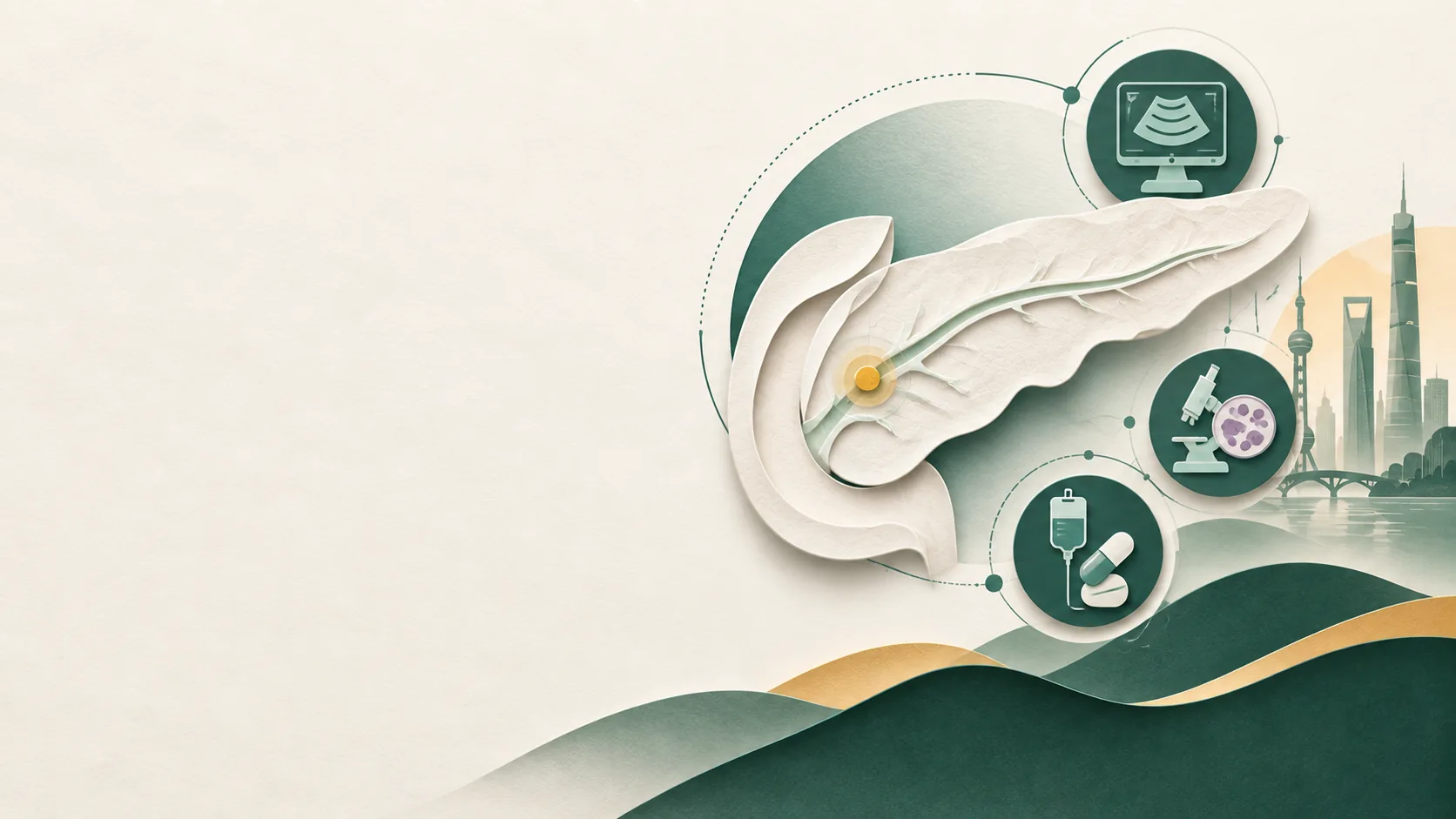
A pancreatic mass on imaging: when does EUS help a Shanghai assessment?
pancreatic mass EUS assessment Shanghai
A pancreatic mass on CT or MRI is the start of a diagnostic decision, not a diagnosis of pancreatic cancer. In Shanghai, a specialist can revisit the original images, decide whether endoscopic ultrasound (EUS) would add useful detail or tissue, and put the result into a clear treatment pathway. The question is what the next test would change for you.
By eastmedgo editorial ·
On this page
Start with what the scan actually describes
Bring the complete CT or MRI report and the original images, not only a photograph of the conclusion. The team needs to understand where the abnormality sits, its appearance, relationship to the pancreatic and bile ducts, and whether other areas need assessment. Previous scans can provide an important comparison. Ask whether the finding is predominantly solid, cystic or associated with inflammation; these are not interchangeable descriptions. Symptoms and examination also matter. A tumour-marker result such as CA19-9 cannot independently confirm or exclude pancreatic cancer.
What EUS adds to CT or MRI
During upper gastrointestinal EUS, a flexible endoscope carries an ultrasound probe close to structures around the stomach and duodenum, including the pancreas. This can help the team examine an area in more detail and, when indicated, guide sampling. It does not mean that cross-sectional imaging becomes unnecessary: scans also show the wider anatomical picture. Ask the specialist to state the unresolved question, such as whether closer assessment or tissue would change the recommendation. Repeating every available scan is not the same as completing an appropriate diagnostic assessment.
Sources and references: [1] [2] [3]
EUS and needle sampling are separate decisions
An ultrasound examination and taking a needle sample are related but distinct parts of the discussion. Tissue can be especially important when the diagnosis is uncertain or treatment requires pathological confirmation. Conversely, selected patients with imaging suggesting an operable pancreatic cancer may proceed to surgery without a preoperative biopsy after specialist assessment; this is not a rule for every mass. If treatment such as chemotherapy is planned first, confirmation is required. The consultation should explain why sampling is recommended now, which result would alter the plan and whether another approach is appropriate.
A result is useful only if it answers the question
A sample may be diagnostic, insufficient or inconclusive. A report saying that cancer cells were not seen must be interpreted with sample quality and the imaging, rather than automatically being treated as proof of a harmless lesion. Changhai researchers' 2015 study specifically examined sampling adequacy in solid pancreatic lesions; its historical figures are not an estimate of today's individual accuracy. If evidence does not agree, ask whether the team recommends pathology review, further imaging, another sample or another management route, and why that step is likely to resolve the uncertainty.
Where Shanghai expertise fits this decision
Shanghai brings focused pancreatic imaging and endoscopy expertise to a problem that often needs several decisions in sequence. At Changhai Hospital, gastroenterology specialist Jin Zhendong works in endoscopic ultrasound; the team has also published research on pancreatic sampling. This makes Shanghai a strong place to ask whether your existing scan is sufficient, whether EUS should include a needle sample, and which specialty should interpret the result with you. Read our pancreatic mass assessment page before choosing the next step. The Chinese Medical Association profile of Jin Zhendong offers more on his EUS expertise.
Discuss preparation and procedure risks before travelling
EUS may involve sedation, and adding needle sampling introduces further considerations. Risks include bleeding, perforation, pancreatitis, infection and adverse reactions to sedation; the individual discussion depends on the planned procedure and health history. Provide medicines, allergies, previous anaesthetic problems and relevant heart or lung conditions. Ask the receiving team for fasting and medication instructions, particularly for blood-thinning and diabetes medicines, rather than stopping anything independently. Clarify whether an accompanying adult is required and how recovery will be supervised. The ultrasound images themselves do not make the whole endoscopic procedure risk-free.
Sources and references: [3]
Keep diagnosis, drainage and results communication distinct
EUS is not another name for ERCP. ERCP can address a blocked bile duct, for example by placing a stent, while EUS often helps assess nearby structures and obtain tissue. The team may discuss both, but each needs a reason. Clarify whether any planned visit is for diagnosis, relief of obstruction or both. If symptoms worsen while arrangements are being made, seek local medical assessment instead of waiting for travel. Agree who will explain the final pathology and what happens if the result arrives after departure; the immediate endoscopy discussion may not be the final diagnosis.
From image review to results: how eastmedgo coordinates the path
Plan the assessment as a sequence rather than booking an endoscopy in isolation: review existing CT or MRI, decide whether EUS and sampling are needed, obtain the pathology result, then discuss the appropriate treatment. eastmedgo understands China’s specialist landscape and can help assemble original imaging and reports, match the right Shanghai endoscopy and pancreatic team, coordinate language and visit arrangements, and make sure the results are available to your doctor at home. We will help clarify the separate costs of consultation, sedation, sampling and pathology. Contact eastmedgo with the imaging report and the question you need answered.
Common questions
Does every pancreatic mass need an EUS-guided biopsy?
No. The choice depends on the imaging, suspected diagnosis, treatment being considered and whether sampling would change management. EUS imaging and needle sampling should each have a clear purpose. A specialist should explain why a test is needed, or why an alternative route is appropriate.
Can a normal CA19-9 result rule out cancer?
No. Some people with pancreatic cancer do not have a raised CA19-9, and an elevated value can occur for other reasons. It is one part of an assessment, not a substitute for clinical evaluation, imaging and tissue assessment when indicated.
Sources and references: [2]
Can I book the flight home for immediately after EUS?
Allow time for sedation recovery and, if a sample is taken, for the final pathology result. A same-day flight can make both recovery and the next decision harder. eastmedgo can help plan the visit around the whole diagnostic sequence, including how the report reaches you after departure.
Sources and references: [3]
Sources and references
- NHS — Pancreatic cancer tests and next steps
- American Cancer Society — Tests for pancreatic cancer
- Cambridge University Hospitals — Endoscopic ultrasound (EUS)
- Chinese Medical Association Publishing House — Jin Zhendong profile, 2025
- Hou and colleagues — Changhai study of EUS sampling in solid pancreatic lesions, 2015