
A child's uncertain genetic variant: what a Shanghai consultation can clarify
child variant uncertain significance counselling Shanghai
A child’s genetic report can feel like an answer at last, yet a variant of uncertain significance (VUS) has not been shown to explain the child’s condition. Shanghai’s value is a joined-up review of the child, the family history and the testing data—so the family leaves with a better care plan and a clear reason for any further test.
By eastmedgo editorial ·
On this page
A gene name does not establish the diagnosis
A report may name a gene associated with a recognised condition while describing the particular change as uncertain. Those statements are compatible: knowledge about the gene does not establish what this specific variant does. A VUS can reflect insufficient or conflicting evidence, rather than a laboratory mistake. Ask the clinician to explain the classification beside the exact variant, not just the disease name found in an internet search. It is neither confirmation of a genetic disorder nor proof that the child has no medical problem.
Match the result to the child's actual difficulties
Clinical correlation means comparing the finding with the child's development, examination, symptoms and relevant investigations. Prepare when difficulties first appeared, skills gained or lost, seizure history if relevant, growth and problems involving other organs. Include important normal findings, because they can help distinguish possible explanations. The specialist may ask whether the gene's known disease pattern and inheritance fit this history. Similar symptoms alone are not sufficient to settle the variant's significance; the laboratory evidence and the clinical assessment must be considered together.
Sources and references: [2] [6]
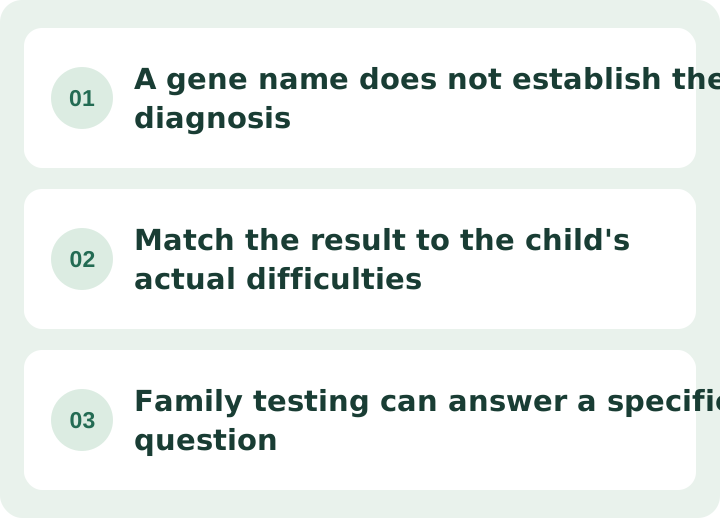
Family testing can answer a specific question
Testing a parent or another relative sometimes helps determine whether the variant travels with particular clinical features or arose newly in the child. It is not automatically useful to test every family member. The genetics team should identify whose sample could change the interpretation and explain limitations, including that some genetic conditions are not expressed in every carrier. This evidence-gathering exercise differs from predictive testing that labels relatives at risk. A VUS should not itself trigger management changes for otherwise unaffected relatives.
Continue appropriate care without treating the VUS as a target
The uncertain result should not, by itself, justify a gene-specific drug, surgery or a change to a relative's screening. However, treatment based on a child's established clinical problems can continue while the cause remains unresolved. Ask which current decisions depend on a confirmed molecular diagnosis and which are supported by the symptoms and examination already available. A medication response does not automatically prove that the variant caused the condition. Do not stop prescribed care while waiting for reclassification; discuss changes with the responsible clinical team.
What a Shanghai multidisciplinary review may add
For a child with symptoms crossing several specialties, Shanghai offers more than another reading of a single gene name. Children’s Hospital of Fudan University has brought clinical specialists together with molecular diagnostics, pathology and imaging in its undiagnosed-disease work. A multidisciplinary review can connect the child’s developmental and medical history to the variant, distinguish useful family testing from repeat testing that adds little, and identify care that should continue now. Explore our pediatric rare-disease assessment guide to see how such questions fit together. Learn more about Fudan’s pediatric multidisciplinary program.
Sources and references: [4]
Bring the full report and clarify consent
Provide the complete laboratory report, test type and date, exact variant notation, classification and any previous parental results. A cropped screenshot may omit why the result was reported or what the test could not detect. Bring key specialist summaries and original relevant investigation reports, with translation needs agreed in advance. Ask whether existing data can be reviewed before a new sample is proposed. If further testing is discussed, clarify possible uncertain or unexpected findings, family implications, who receives results and what permission is needed for sharing records.
Agree how a future change would reach the family
A VUS may later be reclassified as evidence develops, but a new classification is not guaranteed and continuous automatic monitoring should not be assumed. Before leaving the consultation, agree who holds the report, whom the family should contact and what new symptoms or family information should prompt review. Distinguish reassessing this particular variant from reanalysing a wider sequencing dataset: they may answer different questions. Request a written explanation of what remains uncertain and the proposed route for revisiting it, rather than a promise of a fixed date for diagnosis.
How eastmedgo turns the review into a care plan
A good visit produces a practical plan, even if the variant remains uncertain: which symptoms need specialist care now, what evidence could change the interpretation, and who will revisit the result later. eastmedgo knows China’s pediatric specialty network and can help organize the clinical timeline and complete genetic report, match the family with the relevant Shanghai team, coordinate language and visit arrangements, and hand the written plan back to local clinicians. We can also help separate the cost of a genetics consultation from any additional family testing. Tell eastmedgo what your family needs to start with the right question rather than another test package.
Common questions
Does a VUS mean the laboratory found the cause?
No. It means there is not enough evidence to classify that specific finding as disease-causing or harmless. The child's clinical information and further evidence may help, but the result remains uncertain until a justified reassessment changes it.
If a healthy parent has the same variant, is it definitely harmless?
Not necessarily. That observation may be useful, but its meaning depends on the condition, inheritance and whether all carriers would be expected to show symptoms. Ask the genetics team to interpret it alongside the other evidence rather than drawing a conclusion from one family result.
Sources and references: [2]
Should we buy another genetic test before the Shanghai appointment?
Start with the report you already have. A specialist can ask whether the child’s symptoms fit the suspected gene, whether the original data can be reanalysed, and whether targeted testing of relatives would clarify the finding. eastmedgo can help prepare those records for a Shanghai pediatric assessment; a larger new test is useful only when it answers a clinical question.
Sources and references
- NHGRI — Variant of Uncertain Significance (VUS)
- NHS England Genomics Education — Variant of uncertain significance
- NHS — Genetic and genomic testing
- Fudan University — Pediatric undiagnosed disease multidisciplinary center, 2020
- NHS England Genomics Education — Consent conversation for genomic testing
- NHS England Genomics Education — Finding a genomic cause: the clinician's role