
Why treatment may come before surgery for early triple-negative breast cancer
triple negative breast cancer before surgery Shanghai
For some people with early triple-negative breast cancer, medicines before surgery are a planned part of care, not a sign that surgery has been missed. A Shanghai breast team can confirm subtype and stage, explain the preoperative regimen, set a response-assessment point and plan the operation. eastmedgo can organise the record and connect you with the appropriate specialists.
By eastmedgo editorial ·
On this page
Confirm what triple-negative actually means
TNBC describes breast cancer whose tested cells are negative for estrogen and progesterone receptors and do not meet criteria for HER2 positivity. It is a biological subtype, not a stage and not a statement that every treatment will fail. Ask for the complete pathology report, including receptor results and any additional test used to settle an uncertain HER2 result. A short label on a referral letter may omit details that affect interpretation. This article concerns an initial treatment plan for disease without distant spread; recurrent or metastatic TNBC has different treatment questions and should not be assigned the same sequence automatically.
Why some patients start with surgery and others do not
The size and distribution of breast disease, lymph node findings and overall stage help determine whether surgery or systemic treatment comes first. A small tumor that can be removed appropriately may be treated with surgery first. Larger tumors or higher-risk situations may prompt neoadjuvant treatment, meaning treatment before the operation. The decision also considers fitness and the proposed breast and axillary surgery. Ask the team to state the clinical stage, explain any remaining uncertainty about nodes or distant disease, and identify the feature that makes preoperative treatment preferable in your case. TNBC alone is not that complete explanation.
Sources and references: [1] [2]
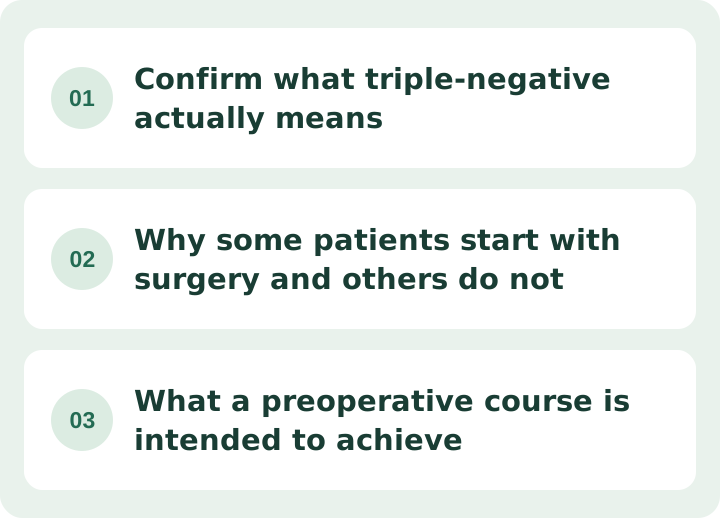
What a preoperative course is intended to achieve
Chemotherapy can reduce the tumor before surgery and treat cancer cells beyond the visible breast mass. Shrinkage may change the extent of breast surgery that is feasible, although breast conservation is not guaranteed. Treating before surgery also lets clinicians assess the tumor's response and use the surgical pathology to inform later decisions. Ask what improvement the team expects to measure, how they will monitor it and what happens if the cancer fails to respond. The plan should name both the planned medicine phase and the subsequent operation; “try treatment first” is not enough to explain the whole pathway.
Sources and references: [2]
Adding immunotherapy requires its own eligibility review
Some patients receive an immune checkpoint inhibitor with chemotherapy as part of a perioperative plan. This is not an automatic addition for every person with TNBC. Stage, the chosen regimen, other illnesses and the relevant local indication all matter. Describe autoimmune disease, previous immune-related problems, organ transplantation and regular medicines to the oncologist rather than deciding eligibility yourself. Ask what added benefit is expected, what risks apply and whether continuation after surgery is planned. A drug mentioned by a US source does not establish approval, supply or insurance coverage in China; these must be checked for the exact regimen.
Prepare for treatment risks before the first cycle
Chemotherapy may cause nausea, fatigue, hair loss, reduced blood counts and infection risk, with additional effects depending on the drugs. Discuss fertility preservation before treatment if relevant, rather than after the course has started. Immune checkpoint medicines can cause inflammation in organs such as the lungs, bowel, liver or endocrine glands; these effects require clinical assessment, not self-treatment as an ordinary cold or stomach upset. Obtain a written symptom and contact plan. Fever during chemotherapy, new breathing difficulty or severe persistent diarrhea warrants prompt medical advice, and severe symptoms need emergency local care instead of waiting for the next planned visit.
Response assessment does not replace the operation
A mass becoming smaller or no longer being obvious on a scan does not by itself prove that all cancer has gone. The team uses examination and imaging during treatment, then evaluates tissue removed at surgery. Ask how the original tumor site will remain identifiable and how lymph nodes will be assessed. Residual disease and other findings may affect postoperative treatment recommendations. Establish who will coordinate surgery if medicine is delivered at home and surgery is planned in Shanghai. Changing countries between phases should not leave unclear responsibility for response assessment, recovery from side effects or the timing of surgical review.
A breast multidisciplinary review has a specific purpose
For early triple-negative breast cancer, the advantage of a specialist review is a continuous plan from medicines through response assessment to surgery. The breast team at Fudan University Shanghai Cancer Center brings pathology, imaging, surgery, medical oncology and radiotherapy together. In Shanghai, you can confirm subtype and stage, understand why preoperative treatment is proposed, agree when response will be assessed and plan what follows the operation. Start with our Triple-negative breast cancer guide, then bring your main question to eastmedgo.
Sources and references: [6]
Compare complete courses and arrange care between cycles
Ask for estimates separating consultation, pathology review, staging, medicines, infusion services, blood tests, supportive medicines, surgery and any later radiation or further drug treatment. Confirm which parts may be provided locally and who is responsible for each prescription and result. A low price for one infusion is not the cost of the full sequence. Before travel, agree how side effects will be managed between visits, what information the surgical team needs and whether the schedule must change after illness or poor recovery. Keep a dated treatment record and an accessible local emergency contact throughout the course. eastmedgo can organise the records needed for confirming TNBC subtype and stage before reassessing preoperative treatment, match you with Shanghai specialists and coordinate bilingual communication and return-home handover. To discuss your records and the next step, contact eastmedgo.
Common questions
Does treatment before surgery mean my cancer is stage IV?
No. Neoadjuvant therapy is used in selected nonmetastatic cases as part of treatment intended to control the cancer and permit an appropriate operation. Stage IV means distant spread; the order of treatment alone does not define it.
Will every patient with TNBC need immunotherapy?
No. Its use depends on the clinical situation, the proposed regimen, health risks and local eligibility. The term triple-negative does not by itself justify adding an immune checkpoint medicine or choosing a dose.
If the scan looks clear, can I cancel surgery?
Do not cancel on that basis. Imaging response is different from examination of tissue after treatment. Ask the treating team how the response changes the operation and later care; a scan alone cannot establish that surgery is unnecessary. Give the breast team the baseline scans, preoperative regimen and response-assessment dates so surgery and later care can be planned together.